

Overview
Get Started
Choose the path that matches your rollout stage.Contact Sales
Request terminals, onboarding guidance, and market enablement support.
Start Quickstart
Set up your first terminal payment flow in less than 10 minutes.
Choose Your Integration Path
Select the integration model that best fits your operations and engineering model.Device-Only Setup
Use the terminal directly with manual amount entry. API and SDK integration are not required.
H2H — Terminal API
Your backend calls Xendit’s cloud HTTP API to create sessions and manage terminal operations centrally.
C2C — Terminal C2C API / SDK
Your POS sends commands over the local network through the C2C API (HTTP) or C2C SDK (native methods).
Why Teams Choose Xendit Terminal
- Regional rollout with one integration: Reuse the same API contract across supported Southeast Asia markets.
- Broad payment acceptance: Support cards, local debit schemes, and QR rails based on country availability.
- Faster deployment: Use streamlined onboarding and operational support to reduce go-live time.
- Flexible operating model: Choose device-only, H2H, or C2C based on checkout flow and device-control requirements.
Coverage by Country
Current market status:- Live markets: Indonesia, Thailand, Vietnam, Malaysia
- Upcoming market: Philippines
How Payments Flow
Most integrations follow this high-level sequence:1
Create a payment request
Your POS or backend creates a payment session and sends transaction amount and terminal details.
2
Customer pays on terminal
The terminal prompts the customer to tap, insert, swipe, or scan, and then processes authorization.
3
Receive status and reconcile
Your system receives payment updates through callbacks or webhooks and closes the transaction.
For detailed request/response flows, callbacks, and edge-case handling, see Terminal API Concepts, Terminal API (H2H) introduction, and Terminal API (C2C) introduction.
Settlement and Operations
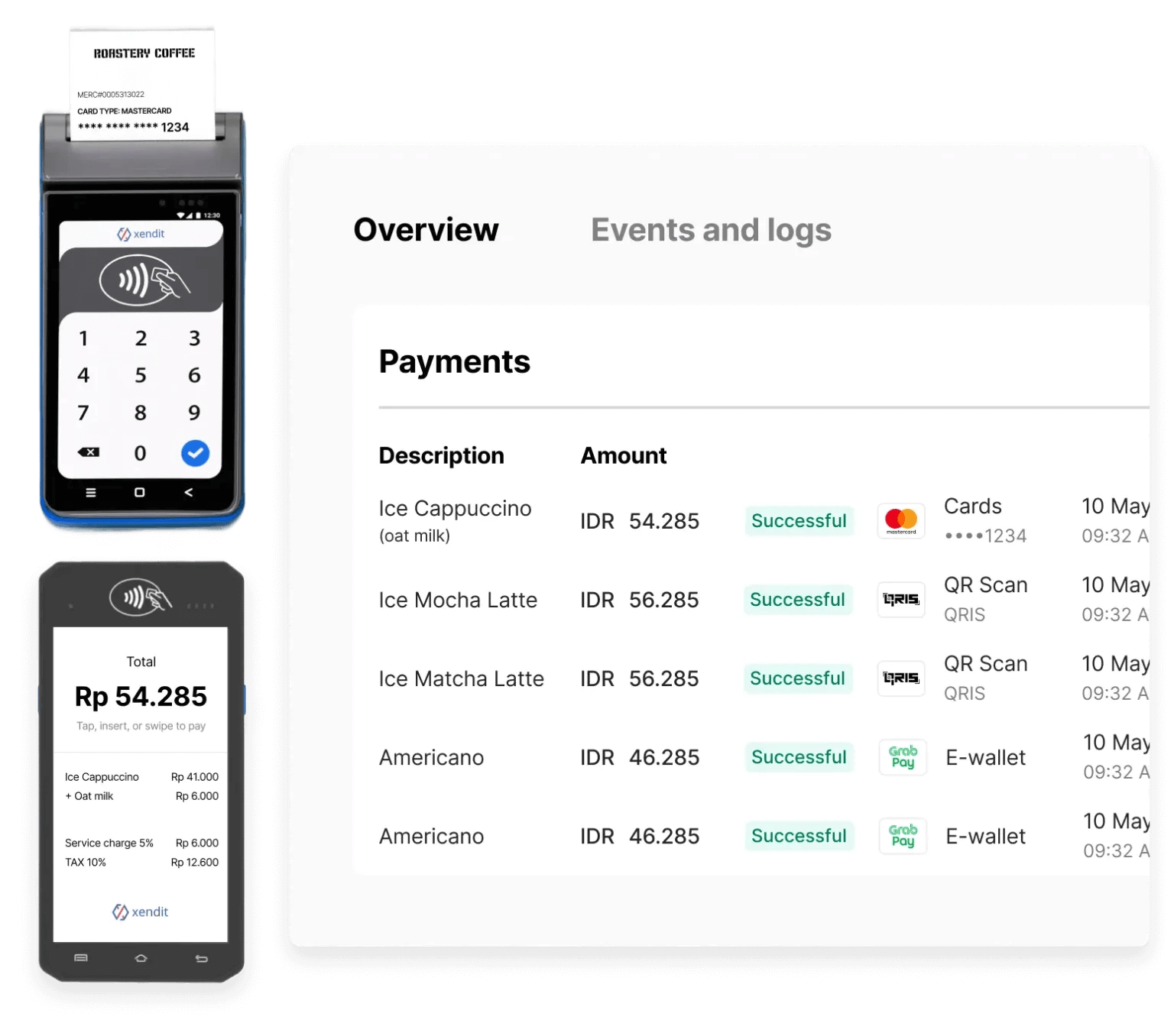
Funds are settled into your Xendit Balance within T+1 day after settlement is completed on the terminal device. Monitor in-person payments in the Xendit Dashboard alongside online transactions for unified reconciliation.Next Steps
Move from evaluation to production with this sequence:1
Apply for terminals
Contact inpersonpayments@xendit.co to request terminals and onboarding support.
2
Integrate and test
Follow the quickstart guide and validate your selected integration track.
3
Launch and operate
Complete certification, deploy terminals, and monitor payments through dashboard reporting and callbacks.