> ## Documentation Index
> Fetch the complete documentation index at: https://terminal-docs.xendit.co/llms.txt
> Use this file to discover all available pages before exploring further.
# iOS SDK (Swift)
> Integrate payment processing with physical terminals using the Terminal C2C SDK for iOS (Swift) - a singleton object for HTTP communication
# Terminal C2C SDK for iOS (Swift)
**The Terminal C2C SDK is a convenience wrapper** around the [Terminal C2C API](/api-reference/c2c/introduction). For providers other than BRI and NTT, you can call the Terminal C2C API directly without the SDK. BRI and NTT terminals require either the [Gateway App](/sdk/gateway/app-configuration) or the C2C SDK as a pre-install.
The Terminal C2C SDK for iOS enables you to integrate secure payment processing directly into your iOS applications. Connect to physical payment terminals through the local Gateway service using the `TerminalC2C` singleton object that handles HTTP communication with the Terminal Gateway.
This SDK uses a singleton pattern with the `TerminalC2C` object to communicate with the Terminal Gateway service via HTTP requests. The SDK provides both async/await and callback-based APIs for payment processing.
## Version information
What's new:
* **Device Connection Observability**: Added `observeConnection()` and `connectionState()` APIs to monitor real-time connection state changes (CONNECTING, CONNECTED, DISCONNECTED, CONNECTING\_FAILED)
* **Error State Observability**: Added `observeError()` and `errorState()` APIs to track terminal errors in real-time with device context
* **Connection Testing**: New `testDeviceConnection()` method to verify terminal reachability before making requests
What's new:
* Fixed casting issue on C2C request payload to improve compatibility and prevent runtime errors.
What's new:
* Added Cashup provider support for Indonesian terminals
What's new:
* Added SHC provider support for Malaysian terminals
* Added multiple-provider support enabling apps to handle different terminal types simultaneously
* Enhanced TerminalDevice configuration with provider-specific methods
* Improved terminal selection for apps managing multiple EDC devices
The SDK follows semantic versioning. Breaking changes will bump the major version number.
## Installation
Install the Terminal SDK using Swift Package Manager (SPM) in Xcode:
In Xcode, open your project and choose **File → Add Package Dependencies...**.
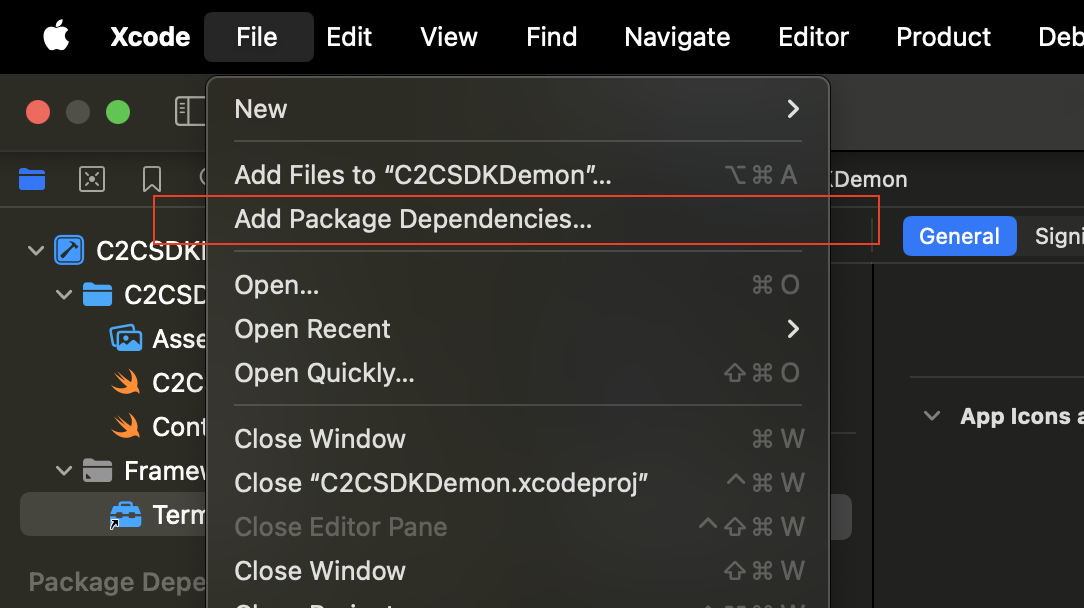 Enter this repository URL in the package search field:
```text theme={null}
https://github.com/xendit/xendit-terminal-ios
```
Then click **Add Package**.
Choose your dependency rule (recommended: **Up to Next Major Version**) and make sure your app target is selected before confirming.
Go to **Build Settings** and make the following changes:
* Search for `ENABLE_USER_SCRIPT_SANDBOXING` and set it to `NO`
* Search for `Other Linker Flags` and add `-lsqlite3`
Enter this repository URL in the package search field:
```text theme={null}
https://github.com/xendit/xendit-terminal-ios
```
Then click **Add Package**.
Choose your dependency rule (recommended: **Up to Next Major Version**) and make sure your app target is selected before confirming.
Go to **Build Settings** and make the following changes:
* Search for `ENABLE_USER_SCRIPT_SANDBOXING` and set it to `NO`
* Search for `Other Linker Flags` and add `-lsqlite3`
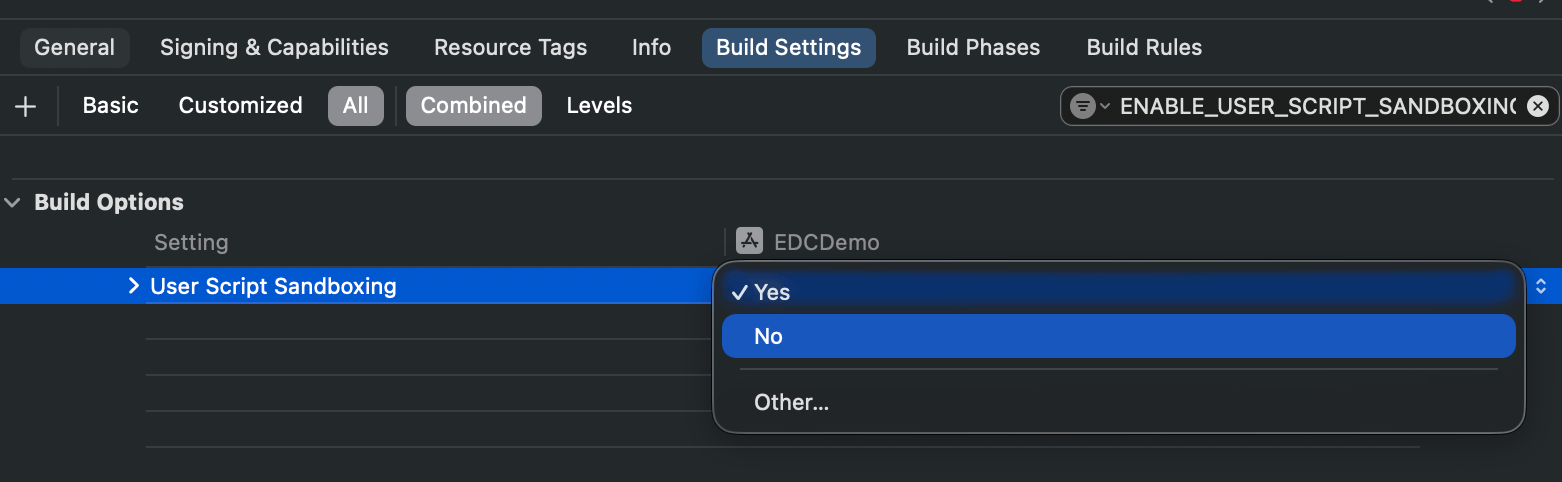
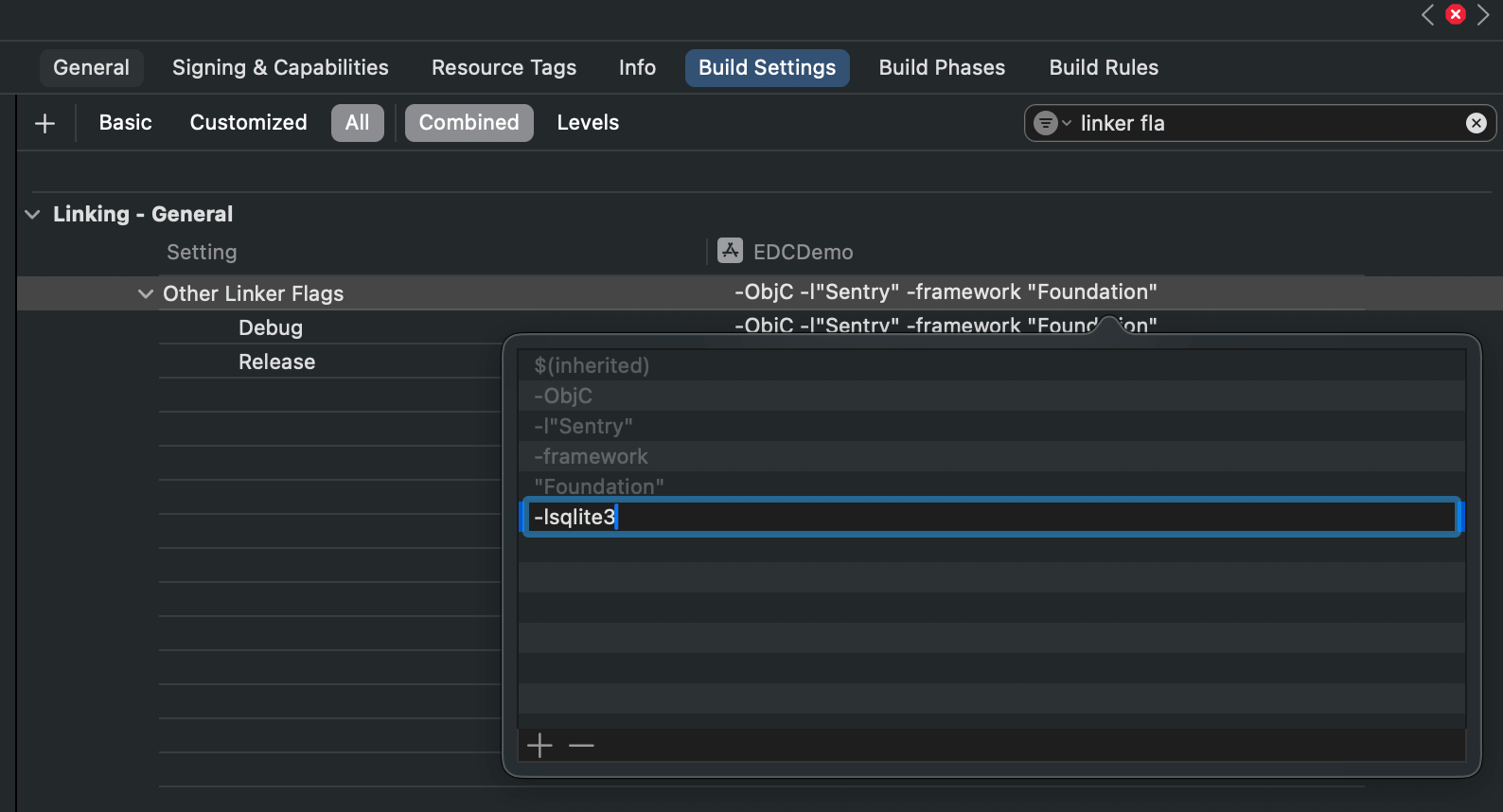 **Optional provider frameworks** - Contact Xendit support for access to:
**Terminal Device Methods:**
* BRI framework: Enables `TerminalDevice.companion.bri()` method for BRI terminals
* NTT framework: Enables `TerminalDevice.companion.ntt()` method for NTT terminals
* Cashup framework: Enables `TerminalDevice.companion.cashup()` method for Cashup provider
* SHC framework: Enables `TerminalDevice.companion.shc()` method for SHC provider
* Not required if using the generic `TerminalDevice.companion.create()` method
## Getting Started
Before starting, you'll need an In-Person Payment CLIENT\_KEY from the Xendit In-Person Payment team. You will also need the terminal [IP address](#finding-terminal-information) and [Terminal ID (TID)](#finding-terminal-information).
### Step 1: Initialize SDK
Call the `TerminalApp.shared.initialize()` method within the Application class of your app:
```swift AppDelegate.swift theme={null}
import TerminalC2C
func application(
_ application: UIApplication,
didFinishLaunchingWithOptions launchOptions: [UIApplication.LaunchOptionsKey: Any]?
) -> Bool {
TerminalApp.shared.initialize(
clientKey: CLIENT_KEY,
mode: TerminalMode.live // or TerminalMode.integration for testing
)
return true
}
```
Replace `CLIENT_KEY` with your actual client key from the Xendit dashboard.
### Step 2: Add Terminal Providers
For Share Commerce (SHC) and Cashup terminals, make sure the Gateway app is installed on the device. If it is missing, install it from the Gateway download page or contact [inpersonpayments@xendit.co](mailto:inpersonpayments@xendit.co) for assistance.
```swift theme={null}
// Add BRI provider for Indonesian terminals
TerminalC2C.shared.addProvider(provider: TerminalBRI.shared)
```
BRI provider supports timeout configuration for card and QR transactions, and provides enhanced transaction retry capabilities.
```swift theme={null}
// Add NTT provider for Thai terminals
TerminalC2C.shared.addProvider(provider: TerminalNTT.shared)
```
NTT provider supports multi-function terminals with card payments and QR code transactions.
```swift theme={null}
// Add Cashup provider for Indonesian terminals
TerminalC2C.shared.addProvider(provider: TerminalCashup.shared)
```
Cashup provider offers simplified integration with essential payment methods.
```swift theme={null}
// Add SHC provider for Malaysian terminals
TerminalC2C.shared.addProvider(provider: TerminalSHC.shared)
```
SHC provider supports Share Commerce terminals with card capabilities for the Malaysia market.
```swift theme={null}
// Add multiple providers
TerminalC2C.shared.addProvider(provider: TerminalBRI.shared)
TerminalC2C.shared.addProvider(provider: TerminalNTT.shared)
TerminalC2C.shared.addProvider(provider: TerminalCashup.shared)
TerminalC2C.shared.addProvider(provider: TerminalSHC.shared)
```
This setup allows your app to work with different terminal types based on your merchant's configuration.
Provider frameworks are optional. You can use the generic `TerminalDevice.companion.create()` method without adding provider-specific frameworks. Provider frameworks enable access to specialized helper methods like `TerminalDevice.companion.bri()`, `TerminalDevice.companion.ntt()`, and `TerminalDevice.companion.cashup()`.
### Step 3: Configure Terminal Device
Set up your terminal device configuration using the [Terminal ID (TID)](#finding-terminal-information) and [IP address](#finding-terminal-information):
Use the generic `create` method:
```swift theme={null}
import TerminalC2C
// Configure the default terminal device
let terminalDevice = TerminalDevice.companion.create(
id: "TERMINAL_ID",
ipAddress: "192.168.1.100",
provider: "BRI" // or "CASHUP", "NTT"
)
TerminalC2C.shared.setTerminalDevice(terminalDevice)
```
Use provider-specific helper methods (available without additional dependencies):
```swift theme={null}
import TerminalC2C
// For BRI terminals
let briDevice = TerminalDevice.companion.bri(
id: "TERMINAL_ID",
ipAddress: "192.168.1.100"
)
// For Cashup terminals
let cashupDevice = TerminalDevice.companion.cashup(
id: "TERMINAL_ID",
ipAddress: "192.168.1.101"
)
// For NTT terminals
let nttDevice = TerminalDevice.companion.ntt(
id: "TERMINAL_ID",
ipAddress: "192.168.1.102"
)
// For SHC terminals
let shcDevice = TerminalDevice.companion.shc(
id: "TERMINAL_ID",
ipAddress: "192.168.1.103"
)
TerminalC2C.shared.setTerminalDevice(briDevice) // or cashupDevice, nttDevice
```
Provider-specific methods are available in the iOS SDK without requiring additional dependencies. You can use `TerminalDevice.companion.bri()`, `TerminalDevice.companion.cashup()`, `TerminalDevice.companion.shc()`, or `TerminalDevice.companion.ntt()` directly.
For apps handling multiple EDC devices, configure each terminal and specify per transaction:
```swift theme={null}
import TerminalC2C
// Configure multiple terminal devices
let cashierTerminal = TerminalDevice.companion.create(
id: "TID001",
ipAddress: "192.168.1.100",
provider: "BRI"
)
let driveThruTerminal = TerminalDevice.companion.create(
id: "TID002",
ipAddress: "192.168.1.101",
provider: "BRI"
)
let selfServiceTerminal = TerminalDevice.companion.ntt(
id: "TID003",
ipAddress: "192.168.1.102"
)
// Use specific terminal per transaction
let payment = Payment(
orderID: "ORDER_123",
amount: 10000.0,
paymentMethod: BRIPaymentMethod.contactless
)
// Specify terminal device per request
Task {
do {
let result = try await TerminalC2C.shared.createPayment(
payment: payment,
device: cashierTerminal, // Use specific terminal
isSimulation: false
)
print("Payment successful: \(result.status)")
} catch {
print("Payment failed: \(error.localizedDescription)")
}
}
```
This approach allows dynamic terminal selection based on business logic, location, or user interaction without setting a global default.
You can also specify a device per request instead of setting a default device.
## Supported Payment Methods by Provider
When using BRI terminal configuration:
| Payment Method | Description | Enum Case |
| --------------- | ----------------------- | ------------------------------ |
| **Insert Card** | Chip card transactions | `BRIPaymentMethod.insertCard` |
| **Contactless** | Tap-to-pay transactions | `BRIPaymentMethod.contactless` |
| **QRIS** | QR code payments | `BRIPaymentMethod.qris` |
| **Brizzi** | E-money card payments | `BRIPaymentMethod.brizzi` |
BRI terminals support both physical card payments and digital payment methods popular in Indonesia.
When using Cashup terminal configuration:
| Payment Method | Description | Enum Case |
| -------------- | -------------------------- | -------------------------- |
| **Card** | Standard card transactions | `CashupPaymentMethod.card` |
| **QRIS** | QR code payments | `CashupPaymentMethod.qris` |
Cashup terminals focus on essential payment methods with card and QRIS support.
When using NTT terminal configuration for Thailand market:
| Payment Method | Description | Enum Case |
| --------------- | ------------------------------ | ------------------------------- |
| **Card** | Credit/debit card transactions | `NTTPaymentMethod.card` |
| **MultiIPP** | Installment payments | `NTTPaymentMethod.multiIpp` |
| **Alipay+** | Alipay transactions | `NTTPaymentMethod.alipayPlus` |
| **WeChat Pay** | WeChat payments | `NTTPaymentMethod.wechatPayCil` |
| **TrueMoney** | TrueMoney wallet | `NTTPaymentMethod.trueMoney` |
| **LINE Pay** | LINE Pay wallet | `NTTPaymentMethod.linePay` |
| **ShopeePay** | Shopee wallet | `NTTPaymentMethod.shopee` |
| **ThaiQR** | Thai QR standard | `NTTPaymentMethod.thaiQrCode` |
| **BBL QRCS** | Visa/Master QR | `NTTPaymentMethod.bblQrcs` |
| **Atome** | Atome BNPL | `NTTPaymentMethod.atome` |
| **Sabuy Money** | Sabuy wallet | `NTTPaymentMethod.sabuyMoney` |
| **Max Me** | Max Me wallet | `NTTPaymentMethod.maxMe` |
NTT terminals provide comprehensive payment method support for the Thai market, including local e-wallets and QR payment standards.
When using SHC terminal configuration for the Malaysia market:
| Payment Method | Description | Enum Case |
| -------------- | ------------------------------ | ----------------------- |
| **Card** | Credit/debit card transactions | `SHCPaymentMethod.card` |
SHC terminals focus on core card acceptance for Malaysia deployments.
Use provider-specific payment method enums (for example `BRIPaymentMethod.contactless`) to avoid string mismatches. Each enum case maps to the underlying string identifier expected by the terminal.
## API Usage
### Create Payment
Process a payment transaction using async/await:
```swift theme={null}
import TerminalC2C
// Create payment data
let payment = Payment(
orderID: "ORDER_123",
amount: 10000.0,
paymentMethod: BRIPaymentMethod.contactless
)
// Execute payment
Task {
do {
let result = try await TerminalC2C.shared.createPayment(payment: payment)
print("Payment successful: \(result.status)")
} catch let error as TerminalException {
print("Payment failed: \(error.message)")
} catch {
print("Error: \(error.localizedDescription)")
}
}
```
### Simulation Testing
Enable simulation mode to exercise payment flows without a physical terminal.
```swift theme={null}
import TerminalC2C
// Optional: enable simulation globally
TerminalC2C.shared.isSimulation = true
// Or pass the flag per request when creating a payment
Task {
do {
let result = try await TerminalC2C.shared.createPayment(
payment: payment,
isSimulation: true
)
print("Simulated payment: \(result.status)")
} catch {
print("Simulation failed: \(error.localizedDescription)")
}
}
```
Reset the simulation flag (`TerminalC2C.shared.isSimulation = false`) and omit the `isSimulation` parameter when moving to physical terminals. Combine simulation mode with the special test amounts (400508 decline, 400509 unavailable, 400711 cancel) to validate error handling before go-live.
### Cancel Payment
Cancel an ongoing payment transaction:
```swift theme={null}
import TerminalC2C
// Create cancel data
let cancel = Cancel(
paymentMethod: BRIPaymentMethod.contactless, // Optional
terminalReference: "123456" // Reference from previous transaction
)
Task {
do {
let result = try await TerminalC2C.shared.cancelPayment(cancel: cancel)
print("Cancellation successful: \(result.status)")
} catch let error as TerminalException {
print("Cancellation failed: \(error.message)")
}
}
```
You can create a `Cancel` object from a previous `TerminalResult` using `Cancel.fromResult(result)`.
### Print Receipt
Trigger receipt printing on the terminal:
```swift theme={null}
import TerminalC2C
// Create receipt data
let receipt = Receipt(
paymentMethod: BRIPaymentMethod.contactless, // Optional
terminalReference: "123456" // Reference from previous transaction
)
Task {
do {
let result = try await TerminalC2C.shared.printReceipt(receipt: receipt)
print("Receipt print command sent: \(result.status)")
} catch let error as TerminalException {
print("Receipt print failed: \(error.message)")
}
}
```
### Perform Settlement
Initiate a settlement (batch close) process:
```swift theme={null}
import TerminalC2C
// Create settlement data
let settlement = Settlement(
paymentMethod: BRIPaymentMethod.contactless // Optional: pass nil for all payment methods
)
Task {
do {
let result = try await TerminalC2C.shared.performSettlement(settlement: settlement)
print("Settlement successful: \(result.status)")
} catch let error as TerminalException {
print("Settlement failed: \(error.message)")
}
}
```
### Get Transaction History
Retrieve transaction history from the terminal:
```swift theme={null}
import TerminalC2C
// Create histories data with optional filters
let histories = Histories(
commands: [CommandType.pay, CommandType.cancel], // Optional: filter by command types
statuses: [Status.success], // Optional: filter by statuses
from: "2024-01-01T00:00:00Z", // Optional: ISO 8601 format start date
to: "2024-01-31T23:59:59Z" // Optional: ISO 8601 format end date
)
Task {
do {
let history = try await TerminalC2C.shared.getHistory(histories: histories)
print("Retrieved history: \(history)")
for transaction in history.transactions {
print("Transaction: \(transaction.status)")
}
} catch let error as TerminalException {
print("Failed to retrieve history: \(error.message)")
}
}
```
## Callback-Based API Usage
For compatibility with older code or specific use cases, callback-based methods are also available. Each `*Async` call returns an `ActionJob` you can cancel and invokes the handler with `(TerminalResult?, KotlinThrowable?)`:
### Create Payment (Callback)
```swift theme={null}
import TerminalC2C
let payment = Payment(
orderID: "ORDER_123",
amount: 10000.0,
paymentMethod: BRIPaymentMethod.contactless
)
let job = TerminalC2C.shared.createPaymentAsync(payment: payment) { value, error in
if let result = value {
print("Payment successful: \(result.status)")
} else if let error = error {
if let terminalError = error as? TerminalException {
print("Terminal error: \(terminalError.message)")
} else {
print("Error: \(error.localizedDescription)")
}
}
}
// Cancel the coroutine if the user backs out of the flow
job.cancel()
```
### Cancel Payment (Callback)
```swift theme={null}
import TerminalC2C
let cancel = Cancel(
paymentMethod: BRIPaymentMethod.contactless,
terminalReference: "123456"
)
let cancelJob = TerminalC2C.shared.cancelPaymentAsync(cancel: cancel) { value, error in
if let result = value {
print("Cancellation successful: \(result.status)")
} else if let error = error {
print("Cancellation failed: \(error.localizedDescription)")
}
}
// Cancel when the request is no longer needed
cancelJob.cancel()
```
### Print Receipt (Callback)
```swift theme={null}
import TerminalC2C
let receipt = Receipt(
paymentMethod: BRIPaymentMethod.contactless,
terminalReference: "123456"
)
let receiptJob = TerminalC2C.shared.printReceiptAsync(receipt: receipt) { value, error in
if let result = value {
print("Receipt print command sent: \(result.status)")
} else if let error = error {
print("Receipt print failed: \(error.localizedDescription)")
}
}
// Optionally cancel if the user exits the receipt screen
receiptJob.cancel()
```
### Perform Settlement (Callback)
```swift theme={null}
import TerminalC2C
let settlement = Settlement(
paymentMethod: BRIPaymentMethod.contactless
)
let settlementJob = TerminalC2C.shared.performSettlementAsync(settlement: settlement) { value, error in
if let result = value {
print("Settlement successful: \(result.status)")
} else if let error = error {
print("Settlement failed: \(error.localizedDescription)")
}
}
// Cancel if the settlement action is no longer required
settlementJob.cancel()
```
### Get History (Callback)
```swift theme={null}
import TerminalC2C
let histories = Histories(
commands: [CommandType.pay, CommandType.cancel],
statuses: [Status.success],
from: "2024-01-01T00:00:00Z",
to: "2024-01-31T23:59:59Z"
)
let historyJob = TerminalC2C.shared.getHistoryAsync(histories: histories) { value, error in
if let historyResult = value {
print("Retrieved history: \(historyResult)")
for transaction in historyResult.transactions {
print("Transaction: \(transaction.status)")
}
} else if let error = error {
print("Failed to retrieve history: \(error.localizedDescription)")
}
}
// Cancel the history request if you no longer need updates
historyJob.cancel()
```
## Configuration and Management
### Test Device Connection
Check if the terminal device is reachable before making requests:
```swift theme={null}
import TerminalC2C
func checkConnection(device: TerminalDevice) async -> Bool {
let result = await TerminalC2C.shared.testDeviceConnection(device: device)
return result != nil
}
```
### Observe Error State
Listen for error updates using Combine or callback approach:
```swift theme={null}
import TerminalC2C
// Using Combine-style StateFlow observation
let errorStateFlow = TerminalC2C.shared.errorState()
// Collect error state changes
Task {
for await error in errorStateFlow {
if let error = error {
print("Terminal error: \(error.message)")
}
}
}
```
### Observe Connection State
Monitor connection state changes:
```swift theme={null}
import TerminalC2C
let device = TerminalDevice.companion.create(
id: "TERMINAL_ID",
ipAddress: "192.168.1.100",
provider: "BRI"
)
// Get connection state flow
let connectionFlow = TerminalC2C.shared.connectionState(device: device)
// Observe connection state changes
Task {
for await state in connectionFlow {
print("Connection state: \(state)")
}
}
```
### Observe Error and Connection with Callbacks
For callback-based observation:
```swift theme={null}
import TerminalC2C
// Observe error
let errorJob = TerminalC2C.shared.observeError { error in
if let error = error {
print("Terminal error: \(error.message)")
}
}
// Observe connection
let device = TerminalDevice.companion.create(
id: "TERMINAL_ID",
ipAddress: "192.168.1.100",
provider: "BRI"
)
let connectionJob = TerminalC2C.shared.observeConnection(device: device) { state in
print("Connection state: \(state)")
}
// Cancel observations when no longer needed
errorJob.cancel()
connectionJob.cancel()
```
## Error Handling
### TerminalException
The SDK throws `TerminalException` for terminal-specific errors:
````swift theme={null}
import TerminalC2C
let payment = Payment(
orderID: "ORDER_123",
amount: 10000.0,
paymentMethod: BRIPaymentMethod.contactless
)
do {
let result = try await TerminalC2C.shared.createPayment(payment: payment)
} catch let error as TerminalException {
let apiError = error.error
switch apiError.code {
case "FAILED_TO_CONNECT":
print("Cannot connect to Terminal Gateway")
case "AUTHENTICATION_FAILED":
print("Authentication failed")
case "TERMINAL_BUSY":
print("Terminal is busy")
default:
print("Error: \(apiError.message)")
}
} catch {
print("Unexpected error: \(error.localizedDescription)")
}
### Error Structure
```swift
struct TerminalException: Error {
let httpStatus: Int
let error: ApiError
}
struct ApiError {
let code: String
let message: String
}
````
## Troubleshooting
For more recovery scenarios across H2H and C2C terminal flows, see the [SDK Troubleshooting Guide](/sdk/troubleshooting).
### Common Issues and Solutions
**Problem**: SDK cannot reach the Terminal Gateway service.
**Solution**:
1. Verify Terminal Gateway service is running locally
2. Check the port configuration (default: 8189)
3. Ensure the terminal device IP address is correct
4. Verify network connectivity between your app and gateway
```swift theme={null}
// Check terminal device IP (using generic method)
let device = TerminalDevice.companion.create(
id: "TERMINAL_ID",
ipAddress: "192.168.1.100", // Verify this IP
provider: "BRI" // or "CASHUP", "NTT"
)
// Or using provider-specific method
// let device = TerminalDevice.companion.bri(
// id: "TERMINAL_ID",
// ipAddress: "192.168.1.100"
// )
// let device = TerminalDevice.companion.cashup(
// id: "TERMINAL_ID",
// ipAddress: "192.168.1.100"
// )
// let device = TerminalDevice.companion.ntt(
// id: "TERMINAL_ID",
// ipAddress: "192.168.1.100"
// )
TerminalC2C.shared.setTerminalDevice(device)
```
**Problem**: Error indicating no terminal device is configured.
**Solution**: Set a default terminal device before making requests:
```swift theme={null}
// Set default device
TerminalC2C.shared.setTerminalDevice(terminalDevice)
// Then make requests
let payment = Payment(
orderID: "ORDER_123",
amount: 10000.0,
paymentMethod: BRIPaymentMethod.contactless
)
Task {
let result = try await TerminalC2C.shared.createPayment(payment: payment)
}
```
**Problem**: Requests fail with authentication errors.
**Solutions**:
1. Verify TerminalApp is initialized with correct client key
2. Check terminal ID matches the configured device
3. Ensure client key has Terminal C2C permissions
```swift theme={null}
// Re-initialize with correct client key
TerminalApp.shared.initialize(
clientKey: CLIENT_KEY,
mode: TerminalMode.live // use TerminalMode.integration for test environments
)
TerminalC2C.shared.initialize(
clientKey: CLIENT_KEY,
)
```
**Problem**: Network-level errors when communicating with gateway.
**Solutions**:
1. Check network connectivity
2. Verify firewall settings allow connections to gateway port
3. Ensure Terminal Gateway service is accessible
4. Check terminal device IP address is reachable
Use network debugging tools to verify connectivity between your app and the Terminal Gateway service.
**Problem**: Issues with async/await syntax or compatibility.
**Solutions**:
1. Ensure you're using iOS 15+ or macOS 12+ for native async/await support
2. Use callback-based methods if targeting older iOS versions
3. Wrap async calls in Task blocks
```swift theme={null}
import TerminalC2C
let payment = Payment(
orderID: "ORDER_123",
amount: 10000.0,
paymentMethod: BRIPaymentMethod.contactless
)
// For iOS 15+
Task {
let result = try await TerminalC2C.shared.createPayment(payment: payment)
}
// For older iOS versions, use callbacks
let legacyJob = TerminalC2C.shared.createPaymentAsync(payment: payment) { value, error in
// Handle value or error
}
legacyJob.cancel()
```
## Best Practices
### Error Handling
Always implement comprehensive error handling:
````swift theme={null}
func processPaymentSafely(orderID: String, amount: Double) async throws -> TerminalResult {
let payment = Payment(
orderID: orderID,
amount: amount,
paymentMethod: BRIPaymentMethod.contactless
)
do {
return try await TerminalC2C.shared.createPayment(payment: payment)
} catch let error as TerminalException {
let apiError = error.error
switch apiError.code {
case "TERMINAL_BUSY":
// Retry after delay
try await Task.sleep(nanoseconds: 5_000_000_000) // 5 seconds
return try await processPaymentSafely(orderID: orderID, amount: amount)
case "FAILED_TO_CONNECT":
// Check connectivity and retry
throw error
default:
throw error
}
}
}
### Task Management
Properly manage async tasks:
```swift
class PaymentViewController: UIViewController {
private var paymentTask: Task?
func processPayment() {
let payment = Payment(
orderID: "ORDER_123",
amount: 10000.0,
paymentMethod: BRIPaymentMethod.contactless
)
paymentTask = Task {
do {
let result = try await TerminalC2C.shared.createPayment(payment: payment)
await MainActor.run {
// Update UI on main thread
self.updateUI(with: result)
}
} catch {
await MainActor.run {
// Handle error on main thread
self.showError(error)
}
}
}
}
deinit {
paymentTask?.cancel()
}
}
````
### Device Management
Manage multiple terminal devices efficiently:
```swift theme={null}
class TerminalManager {
private var devices: [String: TerminalDevice] = [:]
func registerDevice(id: String, ip: String, provider: String) {
// Using generic create method
devices[id] = TerminalDevice.companion.create(id: id, ipAddress: ip, provider: provider)
// Or using provider-specific method
// devices[id] = TerminalDevice.companion.bri(id: id, ipAddress: ip)
// devices[id] = TerminalDevice.companion.cashup(id: id, ipAddress: ip)
// devices[id] = TerminalDevice.companion.ntt(id: id, ipAddress: ip)
}
func processPaymentOnDevice(deviceId: String, orderID: String, amount: Double) async throws -> TerminalResult {
guard let device = devices[deviceId] else {
throw NSError(domain: "TerminalManager", code: -1, userInfo: [NSLocalizedDescriptionKey: "Device not found"])
}
let payment = Payment(
orderID: orderID,
amount: amount,
paymentMethod: BRIPaymentMethod.contactless
)
// Set device and make payment
TerminalC2C.shared.setTerminalDevice(device)
return try await TerminalC2C.shared.createPayment(payment: payment)
}
}
```
## Finding Terminal Information
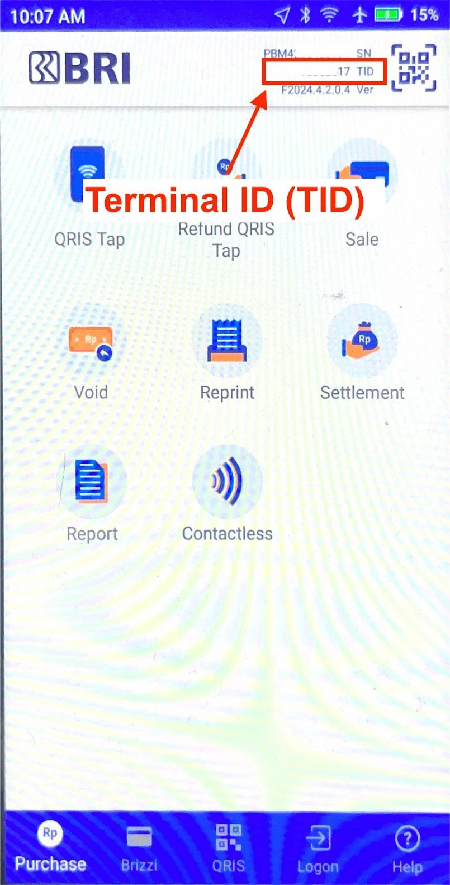
Open the BRI FMS app on the terminal device and locate the Terminal ID in the device information section.
**Optional provider frameworks** - Contact Xendit support for access to:
**Terminal Device Methods:**
* BRI framework: Enables `TerminalDevice.companion.bri()` method for BRI terminals
* NTT framework: Enables `TerminalDevice.companion.ntt()` method for NTT terminals
* Cashup framework: Enables `TerminalDevice.companion.cashup()` method for Cashup provider
* SHC framework: Enables `TerminalDevice.companion.shc()` method for SHC provider
* Not required if using the generic `TerminalDevice.companion.create()` method
## Getting Started
Before starting, you'll need an In-Person Payment CLIENT\_KEY from the Xendit In-Person Payment team. You will also need the terminal [IP address](#finding-terminal-information) and [Terminal ID (TID)](#finding-terminal-information).
### Step 1: Initialize SDK
Call the `TerminalApp.shared.initialize()` method within the Application class of your app:
```swift AppDelegate.swift theme={null}
import TerminalC2C
func application(
_ application: UIApplication,
didFinishLaunchingWithOptions launchOptions: [UIApplication.LaunchOptionsKey: Any]?
) -> Bool {
TerminalApp.shared.initialize(
clientKey: CLIENT_KEY,
mode: TerminalMode.live // or TerminalMode.integration for testing
)
return true
}
```
Replace `CLIENT_KEY` with your actual client key from the Xendit dashboard.
### Step 2: Add Terminal Providers
For Share Commerce (SHC) and Cashup terminals, make sure the Gateway app is installed on the device. If it is missing, install it from the Gateway download page or contact [inpersonpayments@xendit.co](mailto:inpersonpayments@xendit.co) for assistance.
```swift theme={null}
// Add BRI provider for Indonesian terminals
TerminalC2C.shared.addProvider(provider: TerminalBRI.shared)
```
BRI provider supports timeout configuration for card and QR transactions, and provides enhanced transaction retry capabilities.
```swift theme={null}
// Add NTT provider for Thai terminals
TerminalC2C.shared.addProvider(provider: TerminalNTT.shared)
```
NTT provider supports multi-function terminals with card payments and QR code transactions.
```swift theme={null}
// Add Cashup provider for Indonesian terminals
TerminalC2C.shared.addProvider(provider: TerminalCashup.shared)
```
Cashup provider offers simplified integration with essential payment methods.
```swift theme={null}
// Add SHC provider for Malaysian terminals
TerminalC2C.shared.addProvider(provider: TerminalSHC.shared)
```
SHC provider supports Share Commerce terminals with card capabilities for the Malaysia market.
```swift theme={null}
// Add multiple providers
TerminalC2C.shared.addProvider(provider: TerminalBRI.shared)
TerminalC2C.shared.addProvider(provider: TerminalNTT.shared)
TerminalC2C.shared.addProvider(provider: TerminalCashup.shared)
TerminalC2C.shared.addProvider(provider: TerminalSHC.shared)
```
This setup allows your app to work with different terminal types based on your merchant's configuration.
Provider frameworks are optional. You can use the generic `TerminalDevice.companion.create()` method without adding provider-specific frameworks. Provider frameworks enable access to specialized helper methods like `TerminalDevice.companion.bri()`, `TerminalDevice.companion.ntt()`, and `TerminalDevice.companion.cashup()`.
### Step 3: Configure Terminal Device
Set up your terminal device configuration using the [Terminal ID (TID)](#finding-terminal-information) and [IP address](#finding-terminal-information):
Use the generic `create` method:
```swift theme={null}
import TerminalC2C
// Configure the default terminal device
let terminalDevice = TerminalDevice.companion.create(
id: "TERMINAL_ID",
ipAddress: "192.168.1.100",
provider: "BRI" // or "CASHUP", "NTT"
)
TerminalC2C.shared.setTerminalDevice(terminalDevice)
```
Use provider-specific helper methods (available without additional dependencies):
```swift theme={null}
import TerminalC2C
// For BRI terminals
let briDevice = TerminalDevice.companion.bri(
id: "TERMINAL_ID",
ipAddress: "192.168.1.100"
)
// For Cashup terminals
let cashupDevice = TerminalDevice.companion.cashup(
id: "TERMINAL_ID",
ipAddress: "192.168.1.101"
)
// For NTT terminals
let nttDevice = TerminalDevice.companion.ntt(
id: "TERMINAL_ID",
ipAddress: "192.168.1.102"
)
// For SHC terminals
let shcDevice = TerminalDevice.companion.shc(
id: "TERMINAL_ID",
ipAddress: "192.168.1.103"
)
TerminalC2C.shared.setTerminalDevice(briDevice) // or cashupDevice, nttDevice
```
Provider-specific methods are available in the iOS SDK without requiring additional dependencies. You can use `TerminalDevice.companion.bri()`, `TerminalDevice.companion.cashup()`, `TerminalDevice.companion.shc()`, or `TerminalDevice.companion.ntt()` directly.
For apps handling multiple EDC devices, configure each terminal and specify per transaction:
```swift theme={null}
import TerminalC2C
// Configure multiple terminal devices
let cashierTerminal = TerminalDevice.companion.create(
id: "TID001",
ipAddress: "192.168.1.100",
provider: "BRI"
)
let driveThruTerminal = TerminalDevice.companion.create(
id: "TID002",
ipAddress: "192.168.1.101",
provider: "BRI"
)
let selfServiceTerminal = TerminalDevice.companion.ntt(
id: "TID003",
ipAddress: "192.168.1.102"
)
// Use specific terminal per transaction
let payment = Payment(
orderID: "ORDER_123",
amount: 10000.0,
paymentMethod: BRIPaymentMethod.contactless
)
// Specify terminal device per request
Task {
do {
let result = try await TerminalC2C.shared.createPayment(
payment: payment,
device: cashierTerminal, // Use specific terminal
isSimulation: false
)
print("Payment successful: \(result.status)")
} catch {
print("Payment failed: \(error.localizedDescription)")
}
}
```
This approach allows dynamic terminal selection based on business logic, location, or user interaction without setting a global default.
You can also specify a device per request instead of setting a default device.
## Supported Payment Methods by Provider
When using BRI terminal configuration:
| Payment Method | Description | Enum Case |
| --------------- | ----------------------- | ------------------------------ |
| **Insert Card** | Chip card transactions | `BRIPaymentMethod.insertCard` |
| **Contactless** | Tap-to-pay transactions | `BRIPaymentMethod.contactless` |
| **QRIS** | QR code payments | `BRIPaymentMethod.qris` |
| **Brizzi** | E-money card payments | `BRIPaymentMethod.brizzi` |
BRI terminals support both physical card payments and digital payment methods popular in Indonesia.
When using Cashup terminal configuration:
| Payment Method | Description | Enum Case |
| -------------- | -------------------------- | -------------------------- |
| **Card** | Standard card transactions | `CashupPaymentMethod.card` |
| **QRIS** | QR code payments | `CashupPaymentMethod.qris` |
Cashup terminals focus on essential payment methods with card and QRIS support.
When using NTT terminal configuration for Thailand market:
| Payment Method | Description | Enum Case |
| --------------- | ------------------------------ | ------------------------------- |
| **Card** | Credit/debit card transactions | `NTTPaymentMethod.card` |
| **MultiIPP** | Installment payments | `NTTPaymentMethod.multiIpp` |
| **Alipay+** | Alipay transactions | `NTTPaymentMethod.alipayPlus` |
| **WeChat Pay** | WeChat payments | `NTTPaymentMethod.wechatPayCil` |
| **TrueMoney** | TrueMoney wallet | `NTTPaymentMethod.trueMoney` |
| **LINE Pay** | LINE Pay wallet | `NTTPaymentMethod.linePay` |
| **ShopeePay** | Shopee wallet | `NTTPaymentMethod.shopee` |
| **ThaiQR** | Thai QR standard | `NTTPaymentMethod.thaiQrCode` |
| **BBL QRCS** | Visa/Master QR | `NTTPaymentMethod.bblQrcs` |
| **Atome** | Atome BNPL | `NTTPaymentMethod.atome` |
| **Sabuy Money** | Sabuy wallet | `NTTPaymentMethod.sabuyMoney` |
| **Max Me** | Max Me wallet | `NTTPaymentMethod.maxMe` |
NTT terminals provide comprehensive payment method support for the Thai market, including local e-wallets and QR payment standards.
When using SHC terminal configuration for the Malaysia market:
| Payment Method | Description | Enum Case |
| -------------- | ------------------------------ | ----------------------- |
| **Card** | Credit/debit card transactions | `SHCPaymentMethod.card` |
SHC terminals focus on core card acceptance for Malaysia deployments.
Use provider-specific payment method enums (for example `BRIPaymentMethod.contactless`) to avoid string mismatches. Each enum case maps to the underlying string identifier expected by the terminal.
## API Usage
### Create Payment
Process a payment transaction using async/await:
```swift theme={null}
import TerminalC2C
// Create payment data
let payment = Payment(
orderID: "ORDER_123",
amount: 10000.0,
paymentMethod: BRIPaymentMethod.contactless
)
// Execute payment
Task {
do {
let result = try await TerminalC2C.shared.createPayment(payment: payment)
print("Payment successful: \(result.status)")
} catch let error as TerminalException {
print("Payment failed: \(error.message)")
} catch {
print("Error: \(error.localizedDescription)")
}
}
```
### Simulation Testing
Enable simulation mode to exercise payment flows without a physical terminal.
```swift theme={null}
import TerminalC2C
// Optional: enable simulation globally
TerminalC2C.shared.isSimulation = true
// Or pass the flag per request when creating a payment
Task {
do {
let result = try await TerminalC2C.shared.createPayment(
payment: payment,
isSimulation: true
)
print("Simulated payment: \(result.status)")
} catch {
print("Simulation failed: \(error.localizedDescription)")
}
}
```
Reset the simulation flag (`TerminalC2C.shared.isSimulation = false`) and omit the `isSimulation` parameter when moving to physical terminals. Combine simulation mode with the special test amounts (400508 decline, 400509 unavailable, 400711 cancel) to validate error handling before go-live.
### Cancel Payment
Cancel an ongoing payment transaction:
```swift theme={null}
import TerminalC2C
// Create cancel data
let cancel = Cancel(
paymentMethod: BRIPaymentMethod.contactless, // Optional
terminalReference: "123456" // Reference from previous transaction
)
Task {
do {
let result = try await TerminalC2C.shared.cancelPayment(cancel: cancel)
print("Cancellation successful: \(result.status)")
} catch let error as TerminalException {
print("Cancellation failed: \(error.message)")
}
}
```
You can create a `Cancel` object from a previous `TerminalResult` using `Cancel.fromResult(result)`.
### Print Receipt
Trigger receipt printing on the terminal:
```swift theme={null}
import TerminalC2C
// Create receipt data
let receipt = Receipt(
paymentMethod: BRIPaymentMethod.contactless, // Optional
terminalReference: "123456" // Reference from previous transaction
)
Task {
do {
let result = try await TerminalC2C.shared.printReceipt(receipt: receipt)
print("Receipt print command sent: \(result.status)")
} catch let error as TerminalException {
print("Receipt print failed: \(error.message)")
}
}
```
### Perform Settlement
Initiate a settlement (batch close) process:
```swift theme={null}
import TerminalC2C
// Create settlement data
let settlement = Settlement(
paymentMethod: BRIPaymentMethod.contactless // Optional: pass nil for all payment methods
)
Task {
do {
let result = try await TerminalC2C.shared.performSettlement(settlement: settlement)
print("Settlement successful: \(result.status)")
} catch let error as TerminalException {
print("Settlement failed: \(error.message)")
}
}
```
### Get Transaction History
Retrieve transaction history from the terminal:
```swift theme={null}
import TerminalC2C
// Create histories data with optional filters
let histories = Histories(
commands: [CommandType.pay, CommandType.cancel], // Optional: filter by command types
statuses: [Status.success], // Optional: filter by statuses
from: "2024-01-01T00:00:00Z", // Optional: ISO 8601 format start date
to: "2024-01-31T23:59:59Z" // Optional: ISO 8601 format end date
)
Task {
do {
let history = try await TerminalC2C.shared.getHistory(histories: histories)
print("Retrieved history: \(history)")
for transaction in history.transactions {
print("Transaction: \(transaction.status)")
}
} catch let error as TerminalException {
print("Failed to retrieve history: \(error.message)")
}
}
```
## Callback-Based API Usage
For compatibility with older code or specific use cases, callback-based methods are also available. Each `*Async` call returns an `ActionJob` you can cancel and invokes the handler with `(TerminalResult?, KotlinThrowable?)`:
### Create Payment (Callback)
```swift theme={null}
import TerminalC2C
let payment = Payment(
orderID: "ORDER_123",
amount: 10000.0,
paymentMethod: BRIPaymentMethod.contactless
)
let job = TerminalC2C.shared.createPaymentAsync(payment: payment) { value, error in
if let result = value {
print("Payment successful: \(result.status)")
} else if let error = error {
if let terminalError = error as? TerminalException {
print("Terminal error: \(terminalError.message)")
} else {
print("Error: \(error.localizedDescription)")
}
}
}
// Cancel the coroutine if the user backs out of the flow
job.cancel()
```
### Cancel Payment (Callback)
```swift theme={null}
import TerminalC2C
let cancel = Cancel(
paymentMethod: BRIPaymentMethod.contactless,
terminalReference: "123456"
)
let cancelJob = TerminalC2C.shared.cancelPaymentAsync(cancel: cancel) { value, error in
if let result = value {
print("Cancellation successful: \(result.status)")
} else if let error = error {
print("Cancellation failed: \(error.localizedDescription)")
}
}
// Cancel when the request is no longer needed
cancelJob.cancel()
```
### Print Receipt (Callback)
```swift theme={null}
import TerminalC2C
let receipt = Receipt(
paymentMethod: BRIPaymentMethod.contactless,
terminalReference: "123456"
)
let receiptJob = TerminalC2C.shared.printReceiptAsync(receipt: receipt) { value, error in
if let result = value {
print("Receipt print command sent: \(result.status)")
} else if let error = error {
print("Receipt print failed: \(error.localizedDescription)")
}
}
// Optionally cancel if the user exits the receipt screen
receiptJob.cancel()
```
### Perform Settlement (Callback)
```swift theme={null}
import TerminalC2C
let settlement = Settlement(
paymentMethod: BRIPaymentMethod.contactless
)
let settlementJob = TerminalC2C.shared.performSettlementAsync(settlement: settlement) { value, error in
if let result = value {
print("Settlement successful: \(result.status)")
} else if let error = error {
print("Settlement failed: \(error.localizedDescription)")
}
}
// Cancel if the settlement action is no longer required
settlementJob.cancel()
```
### Get History (Callback)
```swift theme={null}
import TerminalC2C
let histories = Histories(
commands: [CommandType.pay, CommandType.cancel],
statuses: [Status.success],
from: "2024-01-01T00:00:00Z",
to: "2024-01-31T23:59:59Z"
)
let historyJob = TerminalC2C.shared.getHistoryAsync(histories: histories) { value, error in
if let historyResult = value {
print("Retrieved history: \(historyResult)")
for transaction in historyResult.transactions {
print("Transaction: \(transaction.status)")
}
} else if let error = error {
print("Failed to retrieve history: \(error.localizedDescription)")
}
}
// Cancel the history request if you no longer need updates
historyJob.cancel()
```
## Configuration and Management
### Test Device Connection
Check if the terminal device is reachable before making requests:
```swift theme={null}
import TerminalC2C
func checkConnection(device: TerminalDevice) async -> Bool {
let result = await TerminalC2C.shared.testDeviceConnection(device: device)
return result != nil
}
```
### Observe Error State
Listen for error updates using Combine or callback approach:
```swift theme={null}
import TerminalC2C
// Using Combine-style StateFlow observation
let errorStateFlow = TerminalC2C.shared.errorState()
// Collect error state changes
Task {
for await error in errorStateFlow {
if let error = error {
print("Terminal error: \(error.message)")
}
}
}
```
### Observe Connection State
Monitor connection state changes:
```swift theme={null}
import TerminalC2C
let device = TerminalDevice.companion.create(
id: "TERMINAL_ID",
ipAddress: "192.168.1.100",
provider: "BRI"
)
// Get connection state flow
let connectionFlow = TerminalC2C.shared.connectionState(device: device)
// Observe connection state changes
Task {
for await state in connectionFlow {
print("Connection state: \(state)")
}
}
```
### Observe Error and Connection with Callbacks
For callback-based observation:
```swift theme={null}
import TerminalC2C
// Observe error
let errorJob = TerminalC2C.shared.observeError { error in
if let error = error {
print("Terminal error: \(error.message)")
}
}
// Observe connection
let device = TerminalDevice.companion.create(
id: "TERMINAL_ID",
ipAddress: "192.168.1.100",
provider: "BRI"
)
let connectionJob = TerminalC2C.shared.observeConnection(device: device) { state in
print("Connection state: \(state)")
}
// Cancel observations when no longer needed
errorJob.cancel()
connectionJob.cancel()
```
## Error Handling
### TerminalException
The SDK throws `TerminalException` for terminal-specific errors:
````swift theme={null}
import TerminalC2C
let payment = Payment(
orderID: "ORDER_123",
amount: 10000.0,
paymentMethod: BRIPaymentMethod.contactless
)
do {
let result = try await TerminalC2C.shared.createPayment(payment: payment)
} catch let error as TerminalException {
let apiError = error.error
switch apiError.code {
case "FAILED_TO_CONNECT":
print("Cannot connect to Terminal Gateway")
case "AUTHENTICATION_FAILED":
print("Authentication failed")
case "TERMINAL_BUSY":
print("Terminal is busy")
default:
print("Error: \(apiError.message)")
}
} catch {
print("Unexpected error: \(error.localizedDescription)")
}
### Error Structure
```swift
struct TerminalException: Error {
let httpStatus: Int
let error: ApiError
}
struct ApiError {
let code: String
let message: String
}
````
## Troubleshooting
For more recovery scenarios across H2H and C2C terminal flows, see the [SDK Troubleshooting Guide](/sdk/troubleshooting).
### Common Issues and Solutions
**Problem**: SDK cannot reach the Terminal Gateway service.
**Solution**:
1. Verify Terminal Gateway service is running locally
2. Check the port configuration (default: 8189)
3. Ensure the terminal device IP address is correct
4. Verify network connectivity between your app and gateway
```swift theme={null}
// Check terminal device IP (using generic method)
let device = TerminalDevice.companion.create(
id: "TERMINAL_ID",
ipAddress: "192.168.1.100", // Verify this IP
provider: "BRI" // or "CASHUP", "NTT"
)
// Or using provider-specific method
// let device = TerminalDevice.companion.bri(
// id: "TERMINAL_ID",
// ipAddress: "192.168.1.100"
// )
// let device = TerminalDevice.companion.cashup(
// id: "TERMINAL_ID",
// ipAddress: "192.168.1.100"
// )
// let device = TerminalDevice.companion.ntt(
// id: "TERMINAL_ID",
// ipAddress: "192.168.1.100"
// )
TerminalC2C.shared.setTerminalDevice(device)
```
**Problem**: Error indicating no terminal device is configured.
**Solution**: Set a default terminal device before making requests:
```swift theme={null}
// Set default device
TerminalC2C.shared.setTerminalDevice(terminalDevice)
// Then make requests
let payment = Payment(
orderID: "ORDER_123",
amount: 10000.0,
paymentMethod: BRIPaymentMethod.contactless
)
Task {
let result = try await TerminalC2C.shared.createPayment(payment: payment)
}
```
**Problem**: Requests fail with authentication errors.
**Solutions**:
1. Verify TerminalApp is initialized with correct client key
2. Check terminal ID matches the configured device
3. Ensure client key has Terminal C2C permissions
```swift theme={null}
// Re-initialize with correct client key
TerminalApp.shared.initialize(
clientKey: CLIENT_KEY,
mode: TerminalMode.live // use TerminalMode.integration for test environments
)
TerminalC2C.shared.initialize(
clientKey: CLIENT_KEY,
)
```
**Problem**: Network-level errors when communicating with gateway.
**Solutions**:
1. Check network connectivity
2. Verify firewall settings allow connections to gateway port
3. Ensure Terminal Gateway service is accessible
4. Check terminal device IP address is reachable
Use network debugging tools to verify connectivity between your app and the Terminal Gateway service.
**Problem**: Issues with async/await syntax or compatibility.
**Solutions**:
1. Ensure you're using iOS 15+ or macOS 12+ for native async/await support
2. Use callback-based methods if targeting older iOS versions
3. Wrap async calls in Task blocks
```swift theme={null}
import TerminalC2C
let payment = Payment(
orderID: "ORDER_123",
amount: 10000.0,
paymentMethod: BRIPaymentMethod.contactless
)
// For iOS 15+
Task {
let result = try await TerminalC2C.shared.createPayment(payment: payment)
}
// For older iOS versions, use callbacks
let legacyJob = TerminalC2C.shared.createPaymentAsync(payment: payment) { value, error in
// Handle value or error
}
legacyJob.cancel()
```
## Best Practices
### Error Handling
Always implement comprehensive error handling:
````swift theme={null}
func processPaymentSafely(orderID: String, amount: Double) async throws -> TerminalResult {
let payment = Payment(
orderID: orderID,
amount: amount,
paymentMethod: BRIPaymentMethod.contactless
)
do {
return try await TerminalC2C.shared.createPayment(payment: payment)
} catch let error as TerminalException {
let apiError = error.error
switch apiError.code {
case "TERMINAL_BUSY":
// Retry after delay
try await Task.sleep(nanoseconds: 5_000_000_000) // 5 seconds
return try await processPaymentSafely(orderID: orderID, amount: amount)
case "FAILED_TO_CONNECT":
// Check connectivity and retry
throw error
default:
throw error
}
}
}
### Task Management
Properly manage async tasks:
```swift
class PaymentViewController: UIViewController {
private var paymentTask: Task?
func processPayment() {
let payment = Payment(
orderID: "ORDER_123",
amount: 10000.0,
paymentMethod: BRIPaymentMethod.contactless
)
paymentTask = Task {
do {
let result = try await TerminalC2C.shared.createPayment(payment: payment)
await MainActor.run {
// Update UI on main thread
self.updateUI(with: result)
}
} catch {
await MainActor.run {
// Handle error on main thread
self.showError(error)
}
}
}
}
deinit {
paymentTask?.cancel()
}
}
````
### Device Management
Manage multiple terminal devices efficiently:
```swift theme={null}
class TerminalManager {
private var devices: [String: TerminalDevice] = [:]
func registerDevice(id: String, ip: String, provider: String) {
// Using generic create method
devices[id] = TerminalDevice.companion.create(id: id, ipAddress: ip, provider: provider)
// Or using provider-specific method
// devices[id] = TerminalDevice.companion.bri(id: id, ipAddress: ip)
// devices[id] = TerminalDevice.companion.cashup(id: id, ipAddress: ip)
// devices[id] = TerminalDevice.companion.ntt(id: id, ipAddress: ip)
}
func processPaymentOnDevice(deviceId: String, orderID: String, amount: Double) async throws -> TerminalResult {
guard let device = devices[deviceId] else {
throw NSError(domain: "TerminalManager", code: -1, userInfo: [NSLocalizedDescriptionKey: "Device not found"])
}
let payment = Payment(
orderID: orderID,
amount: amount,
paymentMethod: BRIPaymentMethod.contactless
)
// Set device and make payment
TerminalC2C.shared.setTerminalDevice(device)
return try await TerminalC2C.shared.createPayment(payment: payment)
}
}
```
## Finding Terminal Information
Open the BRI FMS app on the terminal device and locate the Terminal ID in the device information section.
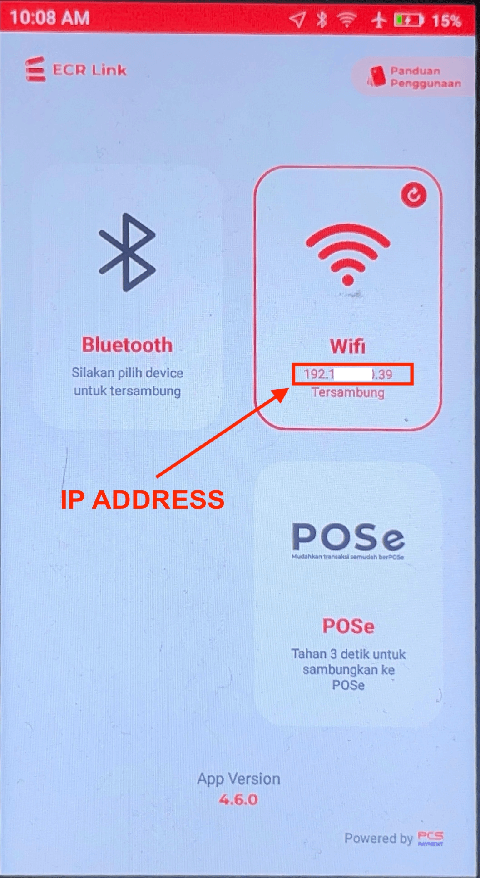
 Open the ECRLink app on the terminal and check the network settings for the IP address.
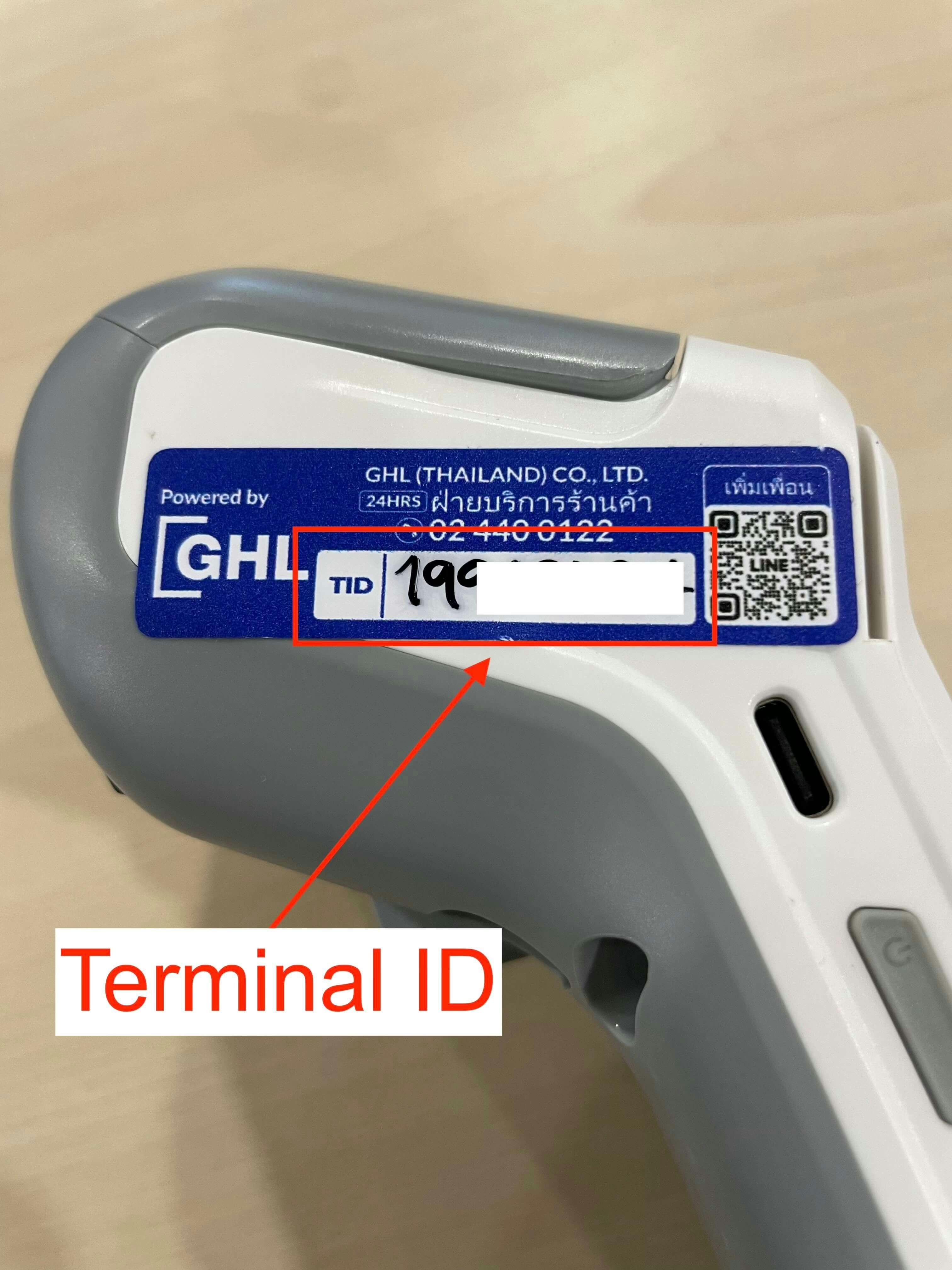
 Look for the Terminal ID on the physical sticker attached to the device.
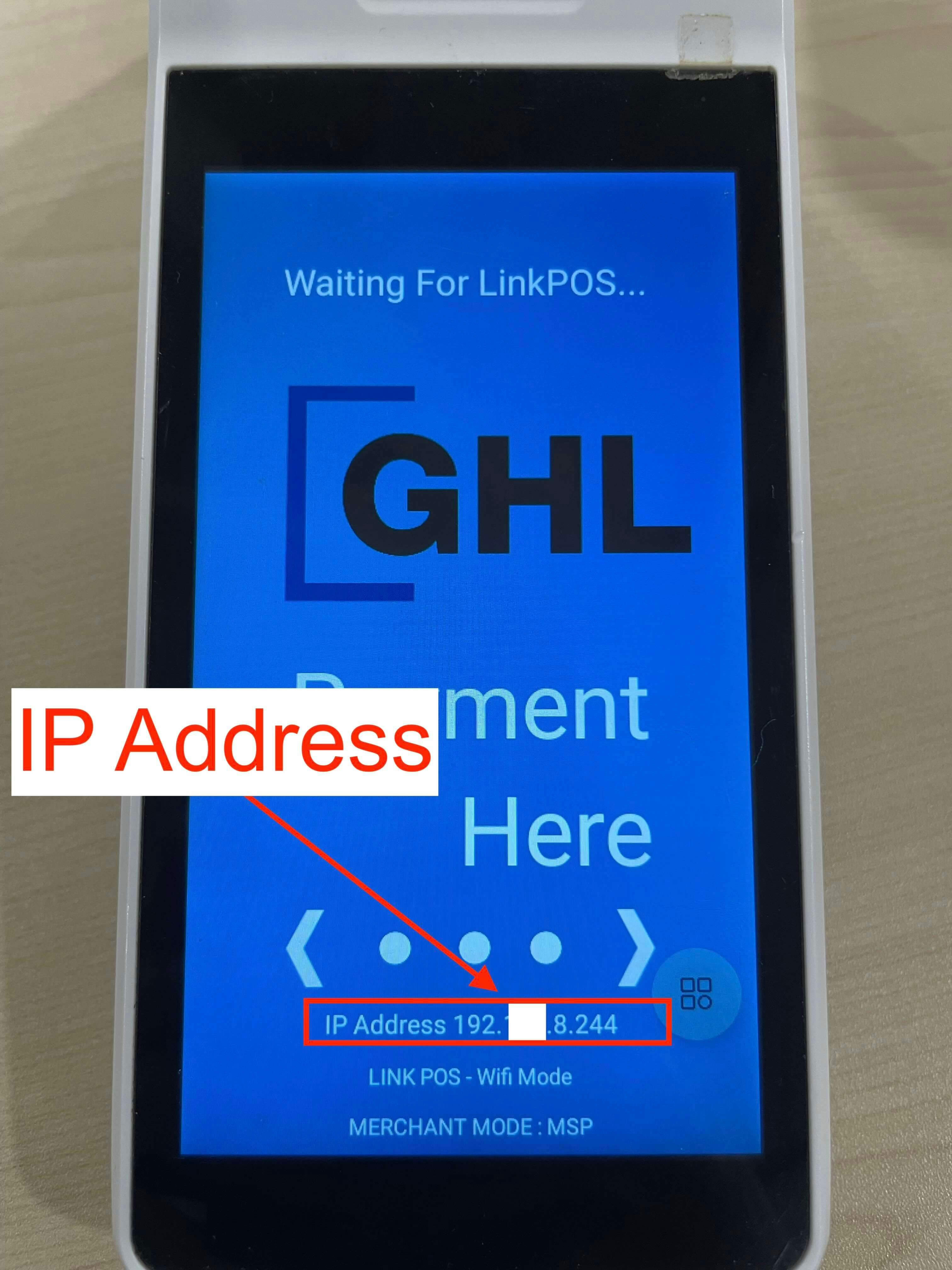
 Open the NTT LinkPOS app on the terminal and navigate to network settings to find the IP address.
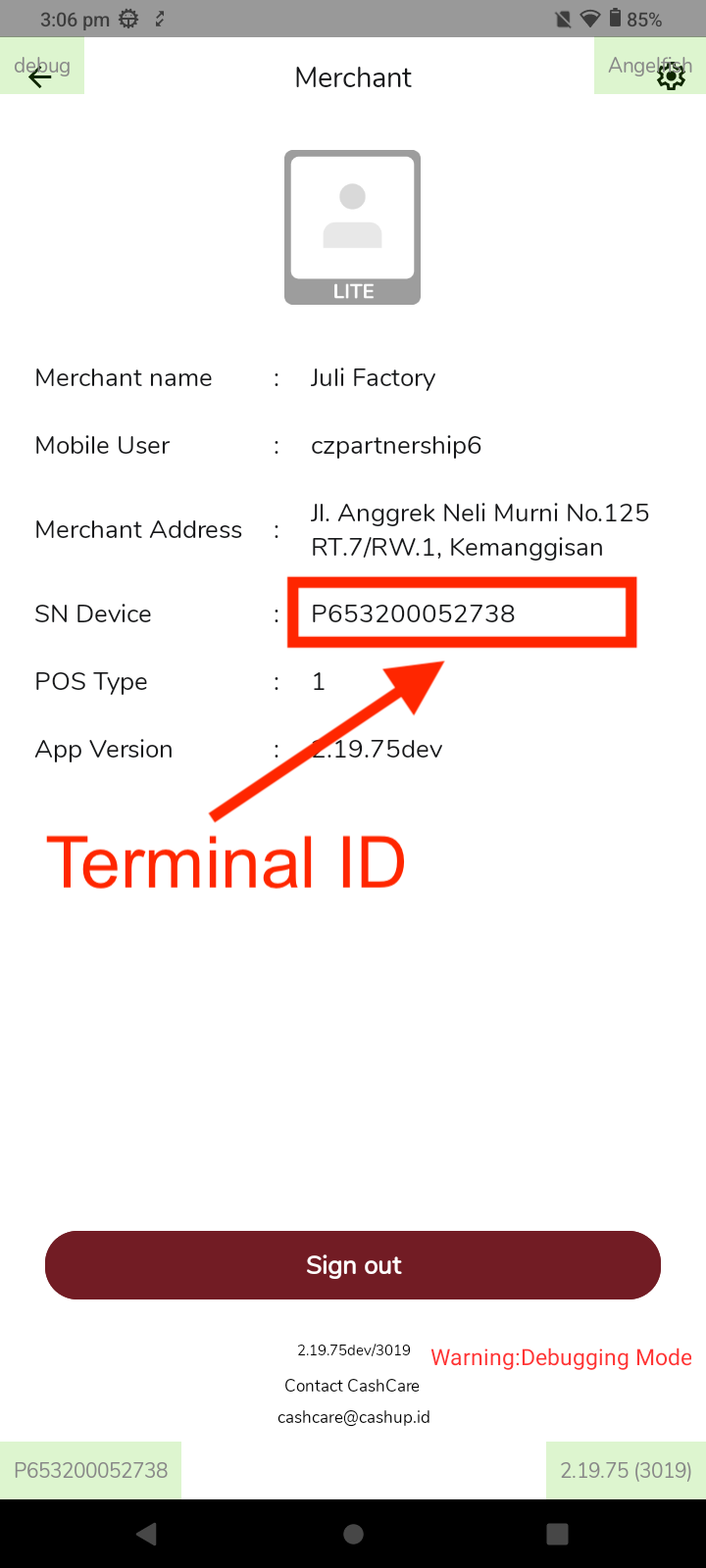
 Open the Cashlez app and navigate to the User Account tab to locate the Terminal ID.
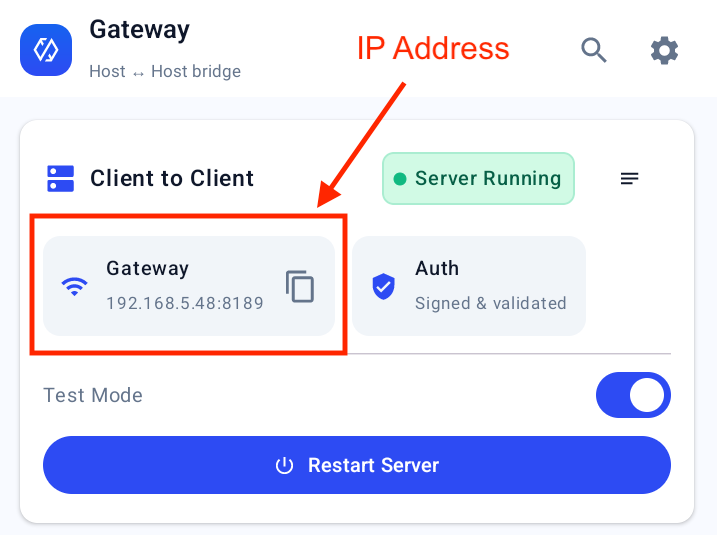
 Open the Terminal Gateway app and check the device list for the terminal IP address.
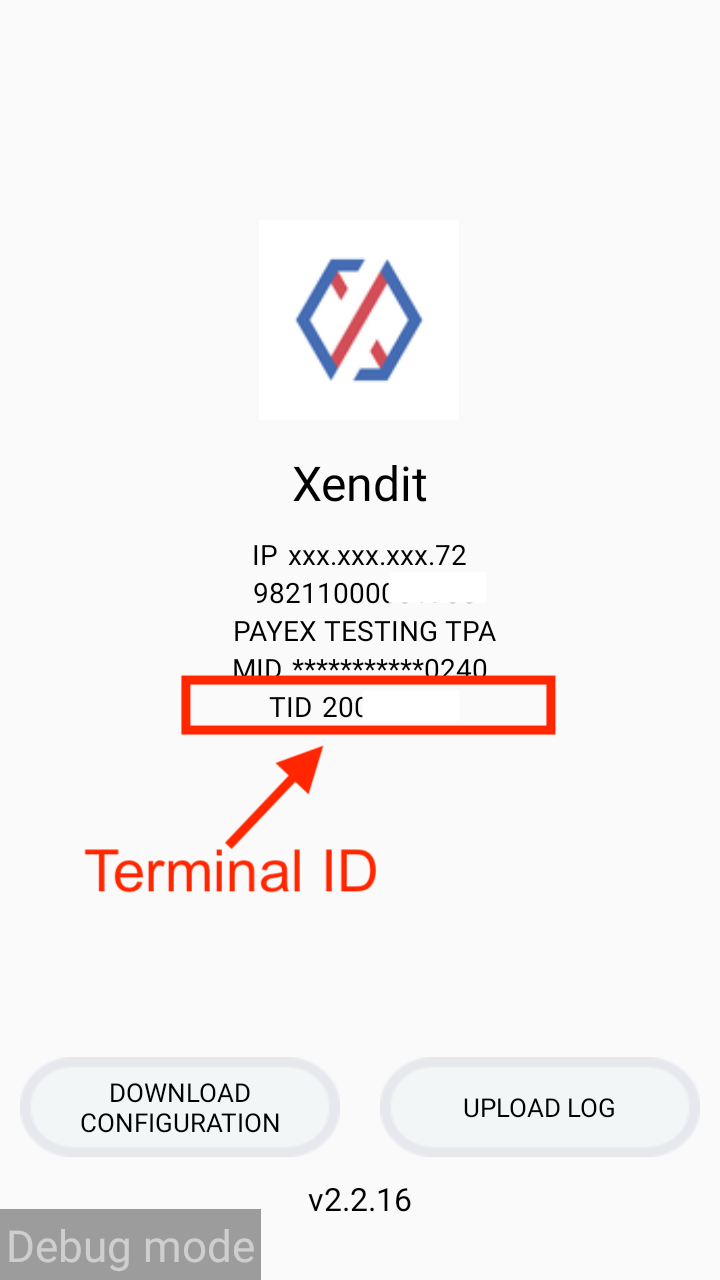
 Open the Xendit app on the device and review the terminal details screen to locate the Terminal ID.
 Open the Terminal Gateway app and check the device list for the terminal IP address.
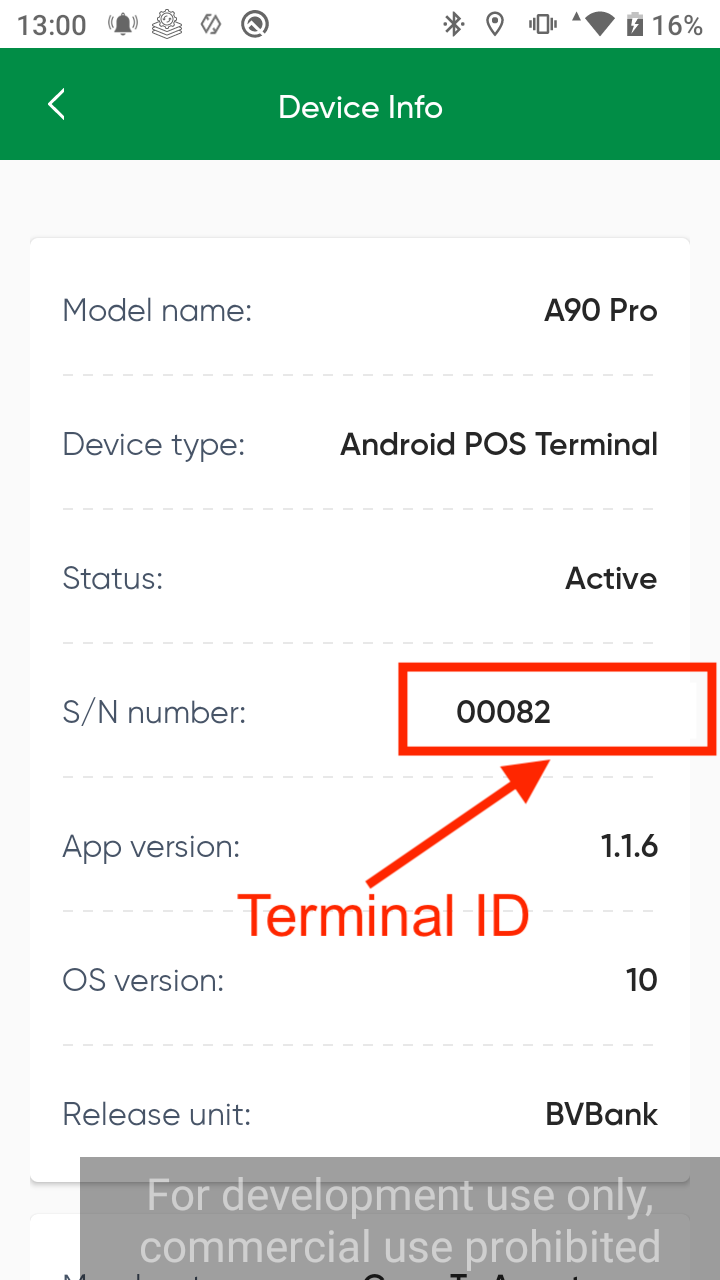
Open the payment app on the Atom terminal, then go to Settings → Device Info to view the Terminal ID.
Open the Terminal Gateway app and check the device list for the terminal IP address.
Open the payment app on the Atom terminal, then go to Settings → Device Info to view the Terminal ID.
 Open the Terminal Gateway app and check the device list for the terminal IP address.
Screenshots and UI layouts may vary by firmware or app version. Refer to the latest vendor documentation if the interface differs from these instructions.
Open the Terminal Gateway app and check the device list for the terminal IP address.
Screenshots and UI layouts may vary by firmware or app version. Refer to the latest vendor documentation if the interface differs from these instructions.